The United Arab Emirates has called on Iran to make a serious commitment to join the community of nations as an accountable member, and to stop arming, funding and enabling radical, violent and extremist entities.
The statement was made in a debate on the 'Principles and Purposes of the UN Charter', chaired by Venezuela, President of the Security Council in February.
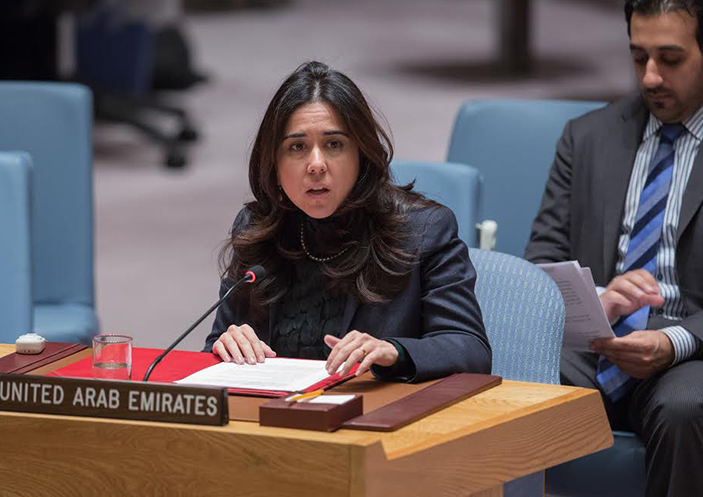
Addressing the Security Council, the UAE Permanent Representative to the United Nations in New York, Lana Zaki Nusseibeh, said that a major cause of instability in the Middle East was the "rise in the rampant use of force against the territorial integrity, sovereignty and political independence of states." She stressed that these actions required more robust responses from the international community, including at the Security Council.
While the UAE welcomed the nuclear agreement reached with Iran last year, the hope for a more constructive Iranian role in the region has failed to materialise, said Ambassador Nusseibeh.
"States throughout the region continue to be alarmed by the Iranian constitution, which calls for the export of its revolution to other countries. The principles of the sovereign equality of Member States and of non-intervention as outlined in Article 2 of the Charter are continually violated by Iran’s successive attempts at destabilisation across the region," she added.
She further noted that Iran’s past behaviour, particularly the occupation by Iranian forces of three islands in the Arabian Gulf that are part of the United Arab Emirates, remains in contravention of Article 2 of the UN Charter. "In accordance with its obligation to the peaceful settlement of disputes, the UAE has been calling on Iran to resume bilateral negotiations, refer the matter to the ICJ, or submit to international arbitration". Yet, she noted, "These calls have gone unheeded so far".
Nusseibeh also addressed the challenge of Daesh and other non-state extremist groups, noting that while the primary responsibility for the grave crimes they commit lies with the extremists themselves, the suffering they impose "is also a consequence of the failure of national governments and the international community, through the United Nations, to deal promptly and effectively, within the international legal framework, with these non-state actors and their backers".
The Security Council’s instruments must be adapted to respond to this evolving threat, said Ambassador Nusseibeh, continuing to ask the question, "What good are travel bans or asset freezes when the culprits evade official documentation such as passports and bank accounts?"
Nusseibeh ended her statement by making several recommendations to the Security Council, including better implementation of existing Security Council resolutions, especially 2216 on Yemen, numerous resolutions on humanitarian access in Syria, as well as a number of resolutions calling for the withdrawal of Israel from the occupied Palestinian territories. She also proposed that the United Nations focus on prevention as a key instrument of peacekeeping, and on mediation, negotiation, arbitration and judicial settlement. Additionally, she said the Security Council must coordinate, consult, and engage with regional organisations and affected states earlier, noting that regional states are closest to the conflicts themselves, and have the greatest interest in their resolution. Finally, she called on the Security Council to apply a single standard to all actors, states and perpetrators of occupation, state terrorism and foreign interference. She said, "Efforts must be redoubled to strengthen accountability by sovereign states, protect those living in conflict and end injustice."
In closing, Ambassador Nusseibeh warned that this is "a watershed year for the United Nations". "Nothing will reflect the intention of the Security Council to re-engage with the Middle East more than its choice of the next Secretary-General," she said, and encouraged the Security Council to take into full account the views of all Member States in its decision.