The United Arab Emirates has reiterated that the delay in resolving the Palestinian cause on the basis of international legitimacy resolutions and Arab peace initiative, was the main reason for threats currently faced by the Middle East.
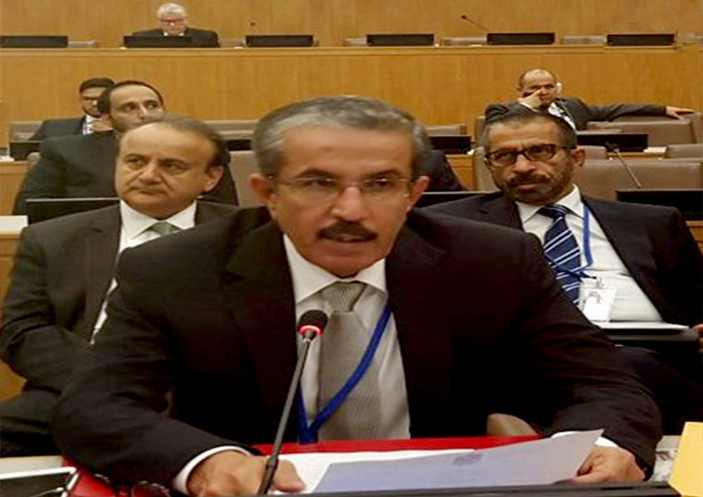
This came in a statement made by Abdullah bin Mohammed Saeed Ghobash, Minister of State, before a coordination meeting of the Organisation of Islamic Cooperation (OIC), held Thursday on the sidelines of the 70th UN General Assembly in New York.
Ghobash said the continuation of Israeli occupation of the Palestinian territories and lack of a just settlement to the Palestinian issue were key reasons for the threats posed at the security and stability of the region and pave the way for extremist groups to exploit the deteriorating humanitarian situation and to influence to embrace their disruptive agenda.
He stressed the importance of focusing OIC's work on rallying regional and international efforts to stop the horrible crimes committed by terrorist groups and to dry up their funding sources.
"The OIC should not only be at the forefront in supporting international counter-terrorism efforts, but also the most active party in rallying such efforts behind the UN's comprehensive strategy to fight terrorism and extremism, he said.
Ghobash referred to the steps taken by the UAE within the international coalition to fight Daesh (ISIL), including setting up of 'Sawab' Centre.
He reiterated UAE's stand, calling for continuous and serious action to maintain unity and political independence of Yemen. He also stressed the need for Houthi rebels to comply with all relevant international resolutions, including the resolution 2216 which calls on them to withdraw their forces and militias from all Yemeni cities, to hand their heavy weapons to the legitimate authority to refrain from blocking humanitarian relief operations, to keep major routes like sea ports and airports, open for humanitarian efforts and to accept internationally recognised political track.
Ghobash also re-affirmed UAE's support to the outcome of the national dialogue aimed at ending the Yemeni crisis, under the aegis of President Abd Rabo Mansour Hadi, as well as support to the efforts made by the UN Special Envoy for Yemen Ismail Ould Cheikh Ahmed, seeking to implement resolution 2216 and to reach a political solution to the crisis in Yemen.
He also said the UAE was committed to providing all forms of support to the Yemeni people, including humanitarian and relief aid to ease their plight, as well as developemnt aid to help rebuild the country's institutions to enable it regain security and stability.
He referred to the Emirates Red Crescent's campaign which raised AED 500 million in aid for Yemen.
On the Libyan crisis, Ghobash expressed UAE's concern over the deteriorating situation and the dangers of terrorism and extremism there. He emphasised the need to intensify efforts in support of the legitimate government in Libya and to contribute in re-building institutions there, including military forces capable of restoring security and stability and of defeating terrorist groups.
He also renewed UAE's support to the efforts of UN special envoy for Libya, Bernardino Leon to reach a political solution in Libya.
Ghobash also stressed UAE's stand calling for ending the Syrian crisis in a way that would fulfil aspirations of the Syrian people towards a political transition based on the Geneva Communique.
He noted that since the onset of the crisis in 2011, the UAE has welcomed more than 100,000 Syrian nationals, raising the total number of Syrians in the UAE to 250,000.
He revealed that the UAE was implementing aid programmes for Syrian refugees in Jordan, Lebanon, Iraq and Turkey, in addition to setting up the Syrian Recovery Trust Fund (SRTF), along with Germany.
Ghobash concluded by urging OIC member countries to give more attention to the human rights matters, women empowerment, fighting human trafficking and importantly, confronting the phenomenon of distoring image of Islam and desecration of a sacred Islamic sites.